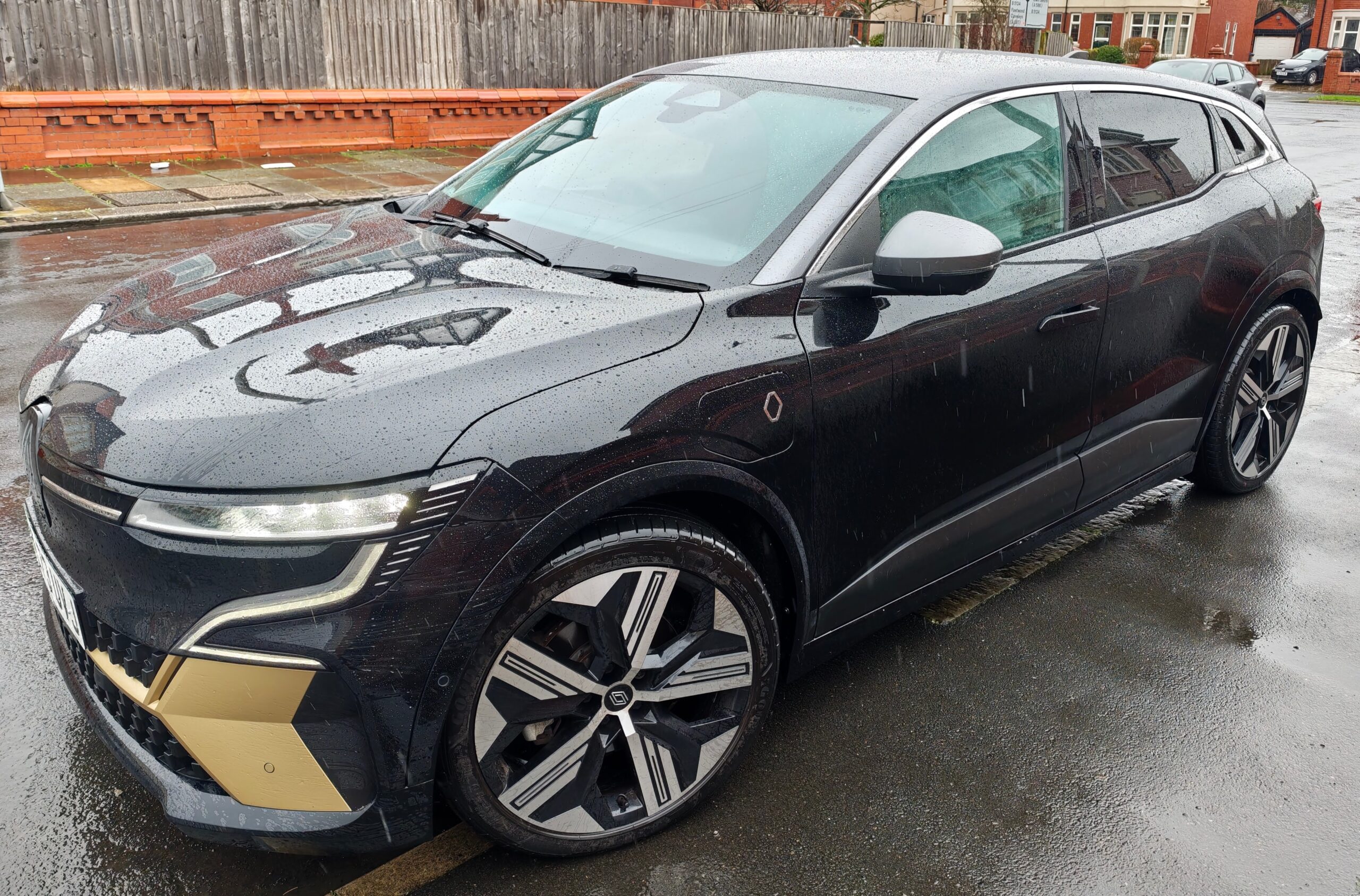
Used Renault Megane E-Tech Review – 73 Plate – 2023 Model
I should be upfront: I am a tech enthusiast, not a car person. I have always found driving more of a necessary inconvenience than a pleasure, and I did not even learn until my mid-thirties. For years, a 16-year-old 1-litre Vauxhall Corsa suited my needs perfectly – I was doing around 2,000 miles a year and just needed something cheap and reliable to get around.
That changed when I took on a new role in IT support. Suddenly, I was commuting daily and regularly heading out for client callouts. The old Corsa, which had been perfectly adequate for occasional use, quickly became a genuine source of stress. Every winter morning involved scraping ice, waiting for the cabin to warm up, and wrestling with almost no in-car technology whatsoever. I had patched things together somewhat using a Technaxx TX-320 Wireless CarPlay and Android Auto display paired with a Soundcore Bluetooth speaker, but that required setting up from scratch each morning and was far from a smooth experience.
After much deliberation, I decided it was time to buy a used electric vehicle. My partner had picked up an MG4 the previous year and found it excellent, and the financial case for used EVs had become increasingly hard to ignore. I get paid 45p per mile for work callouts, home charging costs me around £5 for a full charge, and the severe depreciation that has hit EVs hard since 2022 means buyers in the used market are currently getting a lot of car for the money.
I had originally planned to buy a Hyundai Kona, but after a lengthy period of research I became genuinely interested in the Renault Megane E-Tech. It looked different, it was built on a dedicated EV platform, it came with Google Automotive integration, and the Iconic trim specification was generous. But did it actually deliver in day-to-day use? This review is based on several months of ownership, driving primarily in the north of England through winter and into spring.
Key Specs and Features
The car reviewed is a 73-plate Megane E-Tech Iconic trim with the 60kWh battery and 160kW (217hp) motor. Key specifications are listed below.
| Specification | Detail |
| Trim | Iconic |
| Battery | 60kWh (usable) |
| Motor | 160kW / 217hp, front-wheel drive |
| Torque | 300Nm |
| WLTP Range (claimed) | 280 miles |
| Real-world range (cold) | Approx. 200 miles |
| Efficiency reported | 3.3 miles/kWh (winter average) |
| 0-62mph | 7.5 seconds |
| Top Speed | 160km/h (99mph) |
| AC Charging | 22kW onboard charger (standard) |
| DC Charging | Up to 130kW |
| Infotainment | Google Automotive / OpenR Link |
| Driver Display | 12.3-inch digital |
| Central Screen | 9-inch OpenR touchscreen |
| Audio | Harman Kardon 9-speaker (Iconic) |
| Camera | 360-degree around-view with front and rear cameras |
| Platform | Renault-Nissan CMF-EV (dedicated EV) |
| Boot Capacity | 440 litres / 1,332 litres seats folded |
| Dimensions | 4,200mm long, 1,780mm wide, 1,505mm tall |
| Wheelbase | 2,700mm |
| Weight | Approx. 1,700kg |
| Euro NCAP | 5 stars (85% adult, 88% child) |
Negatives
As the Megane E-Tech has been on sale for a few years, and given that this is a used car purchase, there is little to be gained from a straightforward feature rundown. What matters far more to anyone considering buying one of these is an honest account of the real-world issues. My list of negatives is quite long, but that does not make the Megane a bad car. Most of the problems are relatively minor, and infotainment glitches appear to be a common theme across many brands. All the same, prospective buyers deserve a clear picture before they commit.
Range and Efficiency
Range and efficiency will rightly be the first thing most buyers want to know about, so I will address it plainly. The Megane E-Tech is not the most efficient EV in its class. When I picked it up in January, with cold temperatures, the car was reporting a range of around 200 miles at 100% charge. As the weather has warmed heading into spring, that figure has been creeping upwards.
My daily driving pattern is not ideal for efficiency. The commute involves roughly a mile to the gym, five miles to the office, and a six-mile trip home. Short stop-start journeys in cold weather, with heating running, are about the worst combination for EV efficiency. The car has been consistently returning around 3.3 miles per kilowatt-hour under these conditions. For context, other reviewers testing the car at motorway speeds in milder conditions report around 3.4 miles per kilowatt-hour, which aligns closely with the 200-plus miles of real-world range Renault quote for mixed driving.
For my usage pattern, the range has been perfectly adequate. But if you are looking for class-leading efficiency, it is worth knowing that the Hyundai Kona and Kia Niro both have a stronger reputation in this area, and either would likely return better figures on similar routes. The Megane’s inclusion of a heat pump on Techno+ and Iconic trims does help reduce the efficiency hit from cabin heating in cold weather, but it is not a complete solution.
Google Automotive Infotainment
The infotainment situation is complex. Google Automotive integration is both one of the strongest reasons to buy this car and a persistent source of frustration – and most of that frustration comes from Renault’s approach to software updates rather than the platform itself.
On the day I took the car out for its test drive and returned it to the dealership, a software update notification appeared saying it had downloaded and would install when I left the car. That update failed twice and has not attempted to trigger again since. I now need to take the car into a Renault dealership for a manual software update. This is a thoroughly avoidable situation for what is supposed to be an internet-connected vehicle with over-the-air update capability.
Making matters worse, it appears that some models only slightly older than mine will not receive the latest firmware at all. There have also been widespread reports of the recent OpenRLink 3.1.0 update causing significant issues, with a notable number of users reporting that it breaks the heating system. Given how important climate control is to comfort and range, that is a serious problem.
On a day-to-day level, the Google Maps integration on the driver display sometimes fails to load when I start the car. Initially I suspected this was related to the Wi-Fi hotspot not connecting in time, but it has happened even when connectivity was already established. The map also periodically glitches and reloads, most often when the car comes to a standstill. It has not caused any safety concerns, but seeing the map flash off and on when navigating is not what you expect from a modern car.
The automatic dark and light mode switching is another irritant. Driving under a bridge or into a shaded area can cause the map to flip between modes rapidly, and there does not appear to be any way to lock it to dark mode permanently. These are all things that a software update could fix. That Renault appears unwilling or unable to deliver timely updates makes these small annoyances harder to overlook.
Rear Window and Digital Mirror
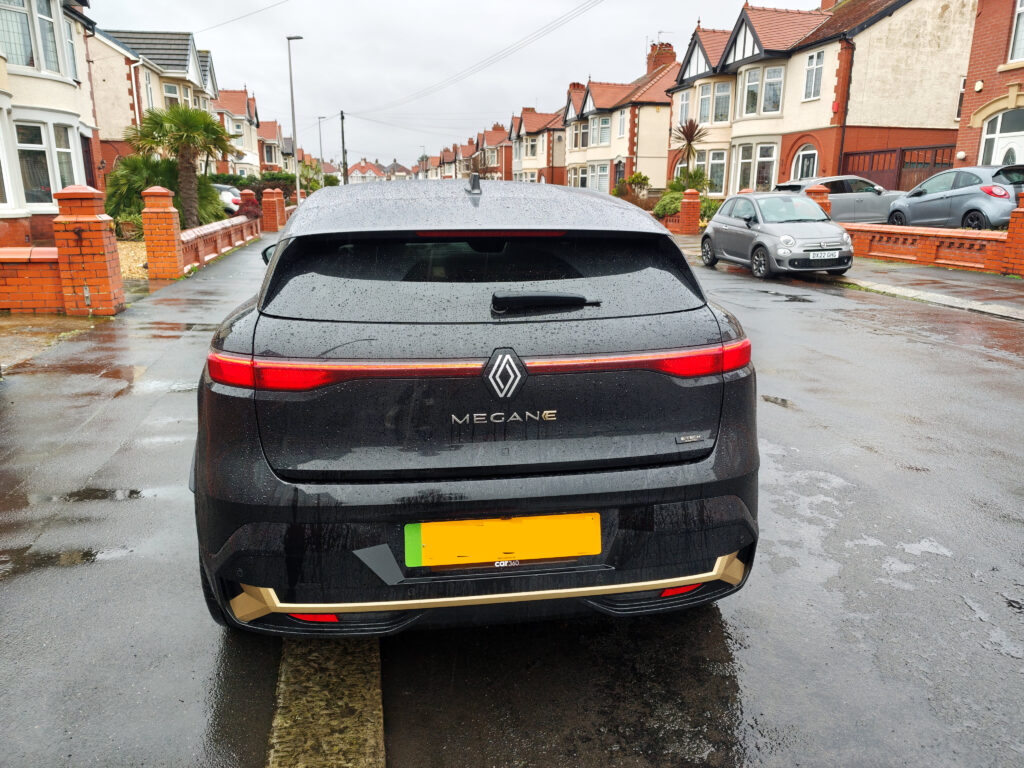
Rear visibility is genuinely poor. The back window is narrow – the word letterbox is not far off the mark – and the rear pillar creates a significant blind spot that makes filtering at junctions something you need to be conscious of. The rear wiper is also undersized for the glass it has to cover.
The digital smart rear-view mirror is included on the Iconic trim and is a reasonable substitute for the limited glass view, but it mists up overnight, meaning you have to wipe the external camera lens each morning before it becomes useful. It is a clever bit of kit, but its practical limitations are worth knowing about in advance.
Failed Front Camera
On the day I collected my car, the front camera stopped working. This appears to be linked to a failed software update and is, unfortunately, not an isolated case. A significant number of owners have reported similar problems, with many requiring either a camera replacement or a replacement of the camera controller module. I have been waiting close to a month for a dealership appointment to have the camera inspected and the software manually updated.
This is frustrating, particularly because the 360-degree camera system and front camera are listed as headline features of the Iconic trim. It is one of the main reasons I chose this specification over cheaper alternatives. In fairness, when I looked at what I would have ended up with had I returned the car and bought something else, I quickly realised that very few competing options include a 360-degree camera system at a comparable price point. The front camera issue is hopefully a case of bad luck, but it is something buyers should factor in.
eSIM and Data Connectivity
The Megane has its own built-in eSIM for connected services. In theory this is convenient; in practice the data subscription is expensive and severely limited in terms of allowance. For anything beyond basic remote notifications, you are essentially paying a premium for very little. Renault’s approach compares unfavourably with brands like Polestar, which have offered extended complimentary data services while they figure out a longer-term pricing model.
My workaround is to keep an old mobile phone in the car with a data SIM and leave the hotspot running permanently. It is not elegant, but it works reliably and means the car’s Google Automotive system always has connectivity when I get in. The phone connects via a power bank rather than the car’s USB ports, to keep it tucked away neatly. It is a faff that should not be necessary on a car of this specification.
Mobile App
The Renault app has a poor reputation among owners and it is not hard to see why. It is slow to connect, limited in what it actually lets you do, and lacks features that many competing apps include as standard. Remote unlocking, for example, is available on the MG iSmart app for the MG4, whereas the Renault app does not offer it. Nor does it allow remote pre-conditioning or car activation.
To be fair, I have found connectivity itself reasonably reliable when it does connect – more so than I expected given the online reputation. But the limited feature set is a genuine limitation. When you consider that Renault is a large automotive manufacturer with substantial resources, the app feels like an afterthought.
Positives
The list of negatives above might paint a bleak picture, but that would be an unfair reading of the overall ownership experience. The Megane E-Tech has a number of genuinely impressive qualities that make it stand out from the competition, and for the right buyer, those positives outweigh most of the gripes listed above.
Appearance
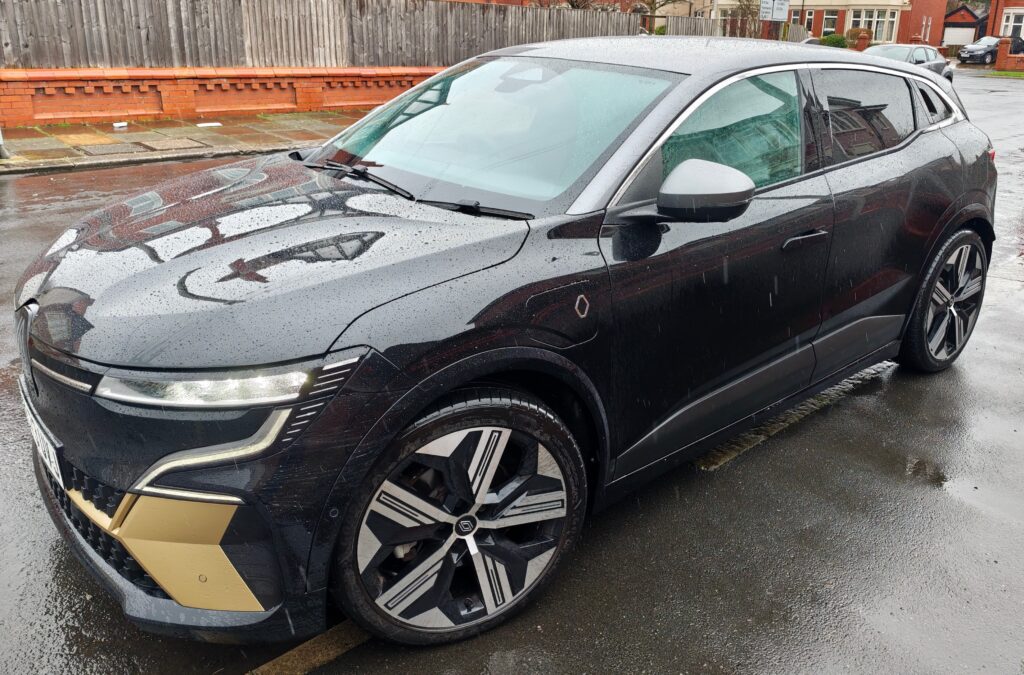
Most of my buying decisions come down to practicality, but the Megane E-Tech’s design was genuinely difficult to ignore. It is one of the better-looking mass-market EVs available at this price point, and the hatchback format is becoming increasingly rare in a segment dominated by SUVs and crossovers. A lot of people have grown tired of the ubiquitous raised SUV look, and the Megane offers a stylish, low-slung alternative.
The Iconic trim’s gold F1 blade is divisive – some love it, others find it a bit much. Personally, I do not mind it, though I think the silver blades on newer model-year cars look slightly cleaner. The 20-inch Enos alloy wheels fill the arches well, and the LED lighting signature front and rear is distinctive without being overdone. The contrasting black roof option on the top two trims also works well in practice.
Inside, the material quality is reasonable for the price bracket. The dashboard features a textile finish that looks and feels premium, and the seat upholstery on Techno and Iconic trims is made from 100 percent recycled materials. Lower down, around the door trims, materials are noticeably harder and more scratchy – this is fairly typical for the class – but the overall cabin impression is positive. The cockpit-style layout, with the screens wrapping around towards the driver, gives the interior a considered feel.
Interior Space and Practicality
Being built on Renault’s CMF-EV dedicated electric platform – developed jointly with Nissan – the Megane makes better use of its footprint than a conventional car converted to battery power. The flat floor is a genuine benefit for front-seat occupants in particular, and the large central storage compartment doubles as an armrest. Compared to the Hyundai Kona, which can feel quite cramped particularly in older versions, the Megane’s front cabin feels airy and spacious.
The rear is less convincing. The low roofline and the way the cabin curves inward at the rear pillars means taller passengers on the outer seats can find headroom a little tight. Foot space in the back is more restricted than you might expect given the flat floor, and fitting three adults across the rear bench is a squeeze. For a family of four with two young children, this will be fine; for regular rear-seat adults, it is worth experiencing before committing.
Boot space is 440 litres with the rear seats in place and 1,332 litres with them folded, which is a competitive figure for the class. There is no front storage compartment, which is a minor disappointment given the dedicated platform. Door bins front and rear are usable, and the wireless charging pad in the centre console is a nice inclusion, even if wireless charging is inherently slower than a cable.
Driver Display
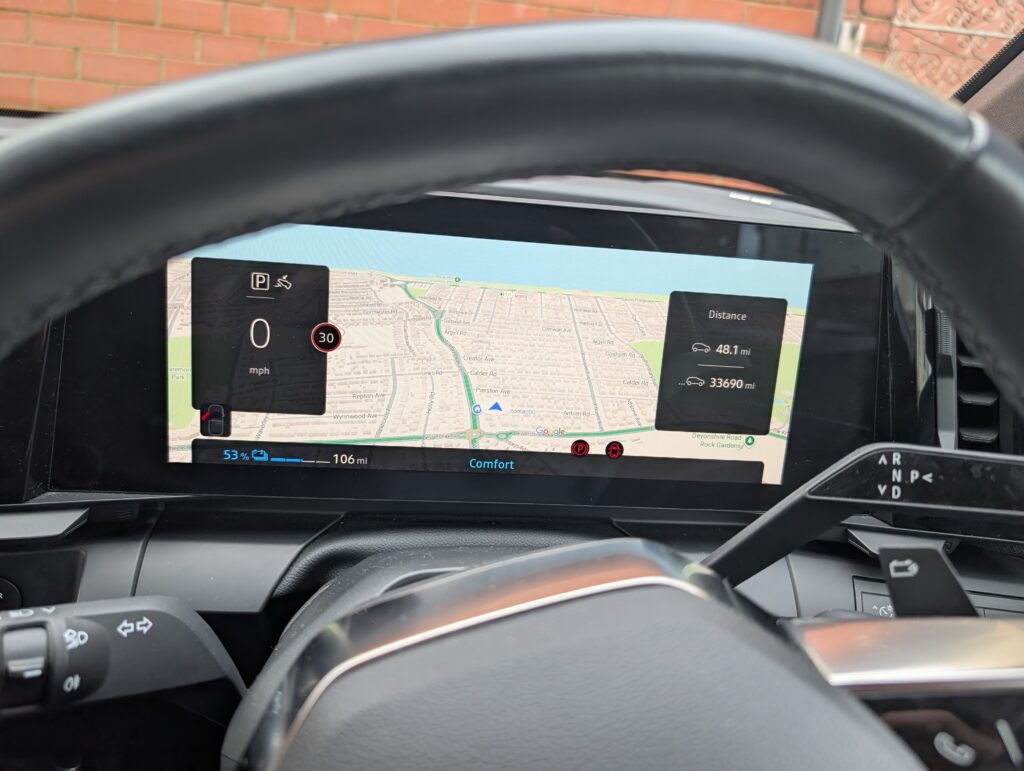
The 12.3-inch digital driver display is one of the highlights of the car. The ability to overlay Google Maps directly onto the driver display is genuinely useful in daily use, reducing the need to glance sideways at the central screen for navigation information. The map is large enough to be genuinely readable at a glance, and for those of us who spend a lot of time navigating unfamiliar roads for work, this is a meaningful feature.
It is not a head-up display, and a head-up display would arguably be better still, but as a practical alternative it works well. Competing cars in this price bracket often make do with smaller digital instrument clusters that cannot display mapping at a useful size. The Megane’s approach here is one of the things that makes it feel like a more considered product than some of the alternatives.
Google Automotive Infotainment
Despite the criticisms above around software updates and glitches, the Google Automotive platform is still one of the strongest reasons to buy the Megane. For Android users in particular, the native Google Maps experience is substantially better than the mapping solutions built into most competing cars. Having access to real-time traffic, Google’s routing algorithm, and a familiar interface without needing to connect a phone is a genuine advantage.
Spotify works natively without needing to be mirrored from a phone, Google Assistant is available for voice commands, and the overall interface is intuitive once you get used to it. Android Auto also works wirelessly over Bluetooth for those who prefer to mirror directly from their phone, whereas some competing options still require a wired connection. Apple CarPlay is also available wirelessly.
My workaround of keeping a SIM-enabled phone in the car for always-on connectivity means that when I get in, everything is ready to go without the slow process of Bluetooth pairing or Android Auto connecting. It adds a small amount of hardware clutter, but in practice it is seamless.
Trip Planning with Charge Planning
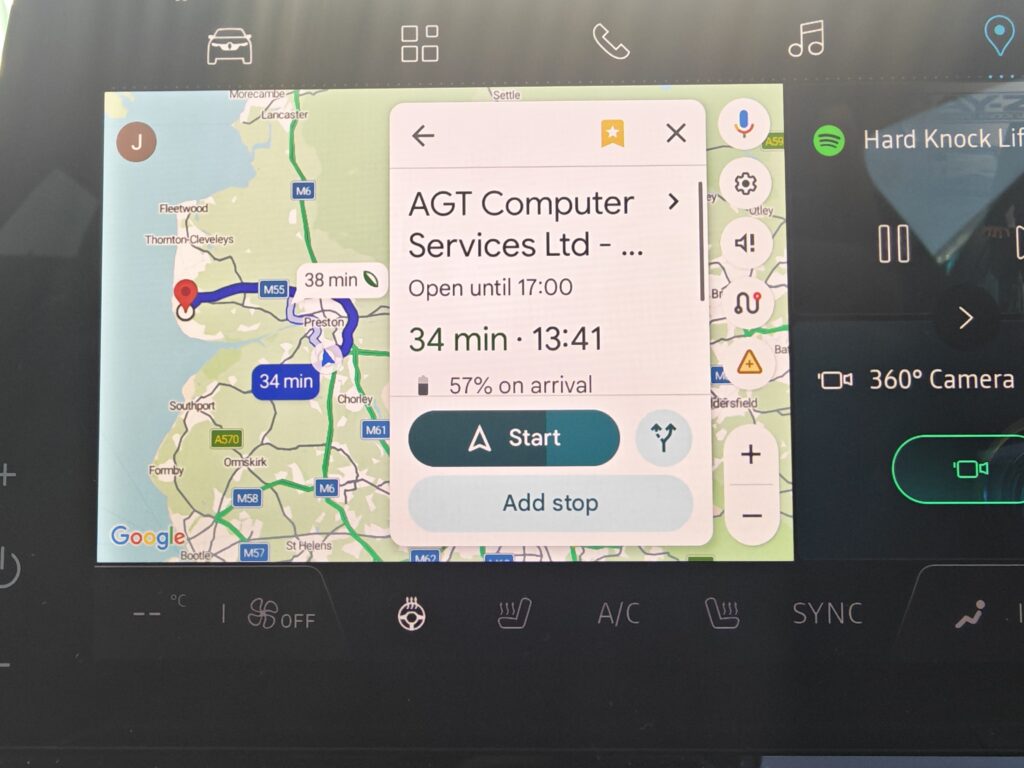
This deserves its own section because it has been genuinely useful. When using native Google Maps navigation, the car integrates battery data with the route to provide estimated charge levels at your destination and for the return journey. On longer routes where charging would be required, it will plot stops at compatible charge points intelligently.
As someone who is new to EVs and prone to range anxiety, having a realistic and accurate battery prediction built into the navigation has been excellent. On a handful of trips of over 100 miles, I have tracked the predictions against the actual outcome. On one journey I arrived with 2 percent more than predicted; on another I arrived with 2 percent less, and that trip involved driving over the hills in the Forest of Bowland in gale-force winds, so the slight shortfall was hardly surprising. The accuracy is good enough to plan with confidence.
Harman Kardon Sound System
The Harman Kardon 9-speaker audio system is exclusive to the Iconic trim and was one of the factors in my decision to specifically look for this specification. Sound quality in cars matters to me – I listen to music constantly when driving, and poor speakers with no low-end punch are a genuine irritant on longer journeys.
The Harman Kardon system in the Megane is excellent for a factory-fitted unit. There is real bass, the soundstage is well-defined, and it holds up well at higher volumes without the distortion or thinness you get from standard fitted speakers. My partner’s MG4, which has a decent audio setup, starts to show its limitations once you push the volume; the Megane’s system holds its composure considerably better. For anyone who spends meaningful time in the car, this alone is worth considering when choosing a trim level.
360-Degree Camera System
The 360-degree around-view camera, which includes front and rear cameras plus a stitched bird’s-eye view, is another Iconic-exclusive feature and one I have found genuinely useful. Coming from a Corsa with no parking sensors and no reversing camera, I may be more impressed by it than someone switching from a car that already had similar technology – but that does not make it any less useful.
The camera quality has been criticised by some reviewers, and it is true that the image resolution is not particularly sharp. But for the purpose it serves – helping you park accurately and avoid obstacles – it works perfectly well. You do not need high-definition detail to know whether you are about to hit a bollard.
When my front camera failed, I surveyed the alternatives available at a comparable price point and found that very few offer 360-degree coverage. The MG4 is one of the few exceptions. The Polestar 2 can have it, but only as part of a paid Pilot pack, which makes working out total cost of ownership considerably more complex. On that basis, the Megane’s camera inclusion in the Iconic trim starts to look like good value.
Driver Assistance Features
The suite of driver assistance features on the Megane Iconic is comprehensive and, in practice, reduces fatigue and stress noticeably on longer or more monotonous drives. The adaptive cruise control with lane centring works well on motorways and takes meaningful effort out of sustained high-speed driving. On roads with clear lane markings, it maintains position confidently. On roads with worn or absent markings, it becomes less reliable, but the lane centring is easily switched off via a dedicated button to the right of the steering wheel – no need to dig through menus.
The speed limiter is the feature I use most on everyday driving. It eliminates the need to constantly monitor the speedometer, which is particularly useful on routes with variable speed limits or average speed camera zones, of which there are an increasing number. It is also worth noting that the Megane’s approach to toggling driving modes via a button on the steering wheel is more convenient than many competitors, which bury these controls in touchscreen menus.
For those coming from a manual car, the automatic transmission and the brake assist and hill hold features are an immediate quality-of-life improvement. These are standard on EVs and automatics generally, but experiencing them daily after years of manual driving makes the difference very tangible. The regenerative braking system, controlled via paddles behind the steering wheel, offers additional deceleration control and is worth experimenting with to find a setting that suits your driving style.
Overall Standard Features
Across most of the trim range, the Megane is well-equipped as standard. All models get a heated steering wheel, heated front seats, ambient lighting, wireless phone charging, keyless entry, and USB-C ports. The Techno trim adds front electric seats with lumbar support, and the Iconic adds the 360-degree camera, Harman Kardon audio, hands-free parking, and the digital rear-view mirror.
Where the Megane compares particularly well against alternatives like the Polestar 2 is in what comes as standard. Heated steering wheels and adaptive cruise control, for example, are extra-cost options on the Polestar 2; on the Megane they are included without additional expense. The Polestar is a better car in various ways, but once you start adding the options needed to replicate the Megane’s standard equipment, the value comparison shifts considerably.
Driving Experience
On the road, the Megane E-Tech is a composed and comfortable companion. The ride quality is good – the suspension feels well-sorted for UK roads, dealing with surface imperfections without transmitting too much into the cabin. The car weighs around 1,700kg, which is relatively light for an electric vehicle, and this contributes to a suspension setup that does not need to be overly stiff to manage body movement.
Steering is light at low speeds, which works well in urban environments and makes manoeuvring straightforward. The turning circle of 10.4 metres is comparable with rivals like the Volkswagen ID.3, and U-turns in confined spaces are manageable. At higher speeds, switching to Sport mode adds weight to the steering and sharpens throttle response, giving the car a noticeably more engaged feel on winding roads.
Performance is respectable rather than exciting. The 160kW motor produces 300Nm of torque and gets the car from 0-62mph in 7.5 seconds. Power delivery is smooth and linear in normal driving, though there is a slight torque steer effect under hard acceleration given the front-wheel-drive layout – particularly on damp roads. In sport mode the car is pleasantly brisk, but it is not designed to be a performance vehicle. Motorway cruising is hushed and relaxed, with wind and road noise well suppressed at legal speeds.
One area where the front-wheel-drive layout shows a limitation is in comparison to rear-wheel-drive competitors like the MG4. The MG4 pushes you out of corners in a way that feels more playful and planted; the Megane pulls from the front, which is less engaging dynamically. For most buyers this will be entirely irrelevant – the Megane is bought for comfort, technology, and usability rather than driving entertainment – but it is worth noting if the driving experience matters to you.
In town, the regenerative braking can be set to maximum via the paddles, bringing the car close to one-pedal driving. It does not quite stop the car completely, so the brake pedal is still needed at junctions, but it is effective enough to minimise brake use on familiar routes. The brake pedal itself feels slightly over-sensitive initially, but most drivers adjust to it within a few days.
Price and Alternative Options
New, the Megane E-Tech starts from £31,295 including the government EV grant. The Techno Esprit Alpine is £34,095, and the Iconic Esprit Alpine sits at the top of the range at £35,495. For the money, the Iconic spec represents solid value on paper, but EV depreciation has been severe enough that buying new is difficult to justify unless you are doing it through a salary sacrifice scheme or as a company director benefiting from the 2% Benefit in Kind rate.
I paid £17,500 for my 73-plate Iconic. At the time of writing, the cheapest Iconic on Autotrader is a 73-plate example with 41 miles on the clock at £15,490, with plenty of options available under £18,000. If you want the updated 24-plate car with the larger 12-inch central display, the cheapest examples are around £19,495 with very low mileage. The used market for these cars is well-stocked and competitively priced.
When I was searching, several alternatives came under consideration:
The Hyundai Kona in facelift form is available with the N Line trim for under £20,000 and has an excellent efficiency reputation. The older design feels more cramped but is very reliable. Either generation represents a sensible, practical choice.
The Polestar 2 is available in the used market from around £12,000 for higher-mileage examples, with plenty of choice in the mid-teens for lower mileage cars. The main complication is that the Polestar 2 has a significant options structure, and working out which cars have which packs – Pilot pack for camera, Plus pack for premium audio and ventilated seats, and so on – makes comparison shopping time-consuming unless you buy direct from Polestar.
The Kia Niro EV is another strong contender, particularly in facelift 4 trim, which adds a panoramic sunroof, ventilated front seats, and electric seat adjustment. Plenty of these are available for around £18,000 with 40,000 to 50,000 miles on the clock. Kia’s reputation for reliability and its seven-year warranty on new cars gives used buyers more confidence than some alternatives.
The Genesis GV60 is an unconventional but interesting choice. It is classified as a luxury SUV, but 2022 models with around 50,000 miles can be found for close to £18,000. The range is longer at 321 miles, and it comes loaded with features including a head-up display. The concerns with this option are higher insurance premiums and the potential cost of maintenance at a Genesis specialist. The dealer network is also thinner than mainstream brands.
The MG4 deserves specific mention. My partner’s MG4 Trophy Long Range was purchased new for a discounted £20,000 and has been thoroughly reliable. For the money it is extraordinarily well-specified, and used 2023 examples with under 20,000 miles are now available for under £14,000. If budget is the primary concern and you are happy to live without the Megane’s refinement and infotainment, the MG4 is hard to argue with.
If I could have stretched my budget slightly beyond £20,000, the Renault Scenic E-Tech would have been seriously tempting. It uses essentially the same mechanical package as the Megane but in a larger body with a substantially bigger battery, giving a theoretical range of 379 miles. For anyone who regularly does longer journeys, the extra cost would be well justified.
Tesla Model 3 and BMW i4 options are also available at similar price points in the used market, with the caveat that i4 examples tend to have higher mileage at comparable prices. Both are worth considering for different reasons, though the Tesla ownership and charging ecosystem comes with its own set of considerations.
Renault Megane E-Tech vs MG4 Trophy Long Range
Having lived with both cars – mine daily, my partner’s as a regular passenger and occasional driver – I can offer a reasonably direct comparison between the two.
The Megane is the more refined car. It rides better, the interior feels more premium, and the infotainment experience is more polished when it is working correctly. The heat pump, included on Techno+ and Iconic trims, does help maintain range in cold weather compared to a car without one, though in practice the range figures for both cars in winter have been broadly similar – the MG4 performs well enough in cold conditions that the heat pump advantage is less pronounced than expected. In warmer weather the MG4 may actually edge ahead on efficiency.
The Google Automotive integration on the Megane is a genuine differentiator versus the MG4’s system, which relies on Android Auto or Apple CarPlay mirroring. For an Android user who uses Google Maps constantly, native integration without needing to plug in or pair a phone is a meaningful advantage. The Megane’s driver display, showing maps directly in front of the driver, is also notably better than anything the MG4 offers at an equivalent price point.
On reliability, we have actually had fewer issues with the MG4 than the Megane – though a large part of that is because my partner rarely ventures beyond Android Auto, so she never interacts with the native infotainment enough to encounter its glitches. The lane-keeping assist on the MG4 is quite aggressive and has a habit of surprising you when it activates unexpectedly.
For value, the MG4 wins straightforwardly. The spec-for-money ratio is exceptional, particularly when bought new at the discounts that have been available. As a used car, the MG4 is now available at prices that make it one of the best value EVs on the market, full stop.
My overall view is that the Megane is the better car to own and drive daily, and I prefer it as a used purchase. But if I were in the market for a new car rather than a used one, the MG4’s combination of specification and aggressive pricing would be very difficult to walk away from.
Overall
The Renault Megane E-Tech is far from a perfect car. The software update situation from Renault is the most frustrating aspect of ownership, not because the underlying platform is bad, but because it is entirely avoidable. A manufacturer selling a connected car with over-the-air update capability should be delivering those updates reliably and regularly. Renault’s record on this is poor, and it means that buyers are left with known bugs and glitches that could be fixed but are not.
The eSIM situation, the limited mobile app, and the front camera failure on my specific car all add to a picture of a product that could have been better supported by the brand behind it. These are not fundamental problems with the car’s architecture or engineering – they are service and software shortcomings.
Set that aside, and the Megane E-Tech Iconic is a genuinely impressive used buy. The Google Automotive integration, the large driver display with mapped navigation overlaid, the Harman Kardon sound system, the 360-degree camera, and the comprehensive driver assistance features all add up to a well-rounded package that is difficult to find at this price point from a competing brand. The dedicated CMF-EV platform gives it better interior space than converted-platform rivals, and the hatchback design is a welcome change from the sea of identical crossovers in this market segment.
The Megane earned a five-star Euro NCAP rating and has won awards including Small Car of the Year at the Company Car and Van Awards 2025 and Best Electric Hatch at the Top Gear Electric Awards in 2022. Those accolades reflect a car that the automotive press has consistently rated well, and my real-world ownership experience broadly agrees with that consensus – with the caveat that Renault’s software and support infrastructure has not kept pace with the quality of the underlying vehicle.
Is it the best used EV at this price point? Probably not – the MG4 offers more for the money, and the Hyundai Kona and Kia Niro both have stronger efficiency reputations. But the Megane is a car that is genuinely enjoyable to use daily, looks good, and packs a specification that would cost considerably more from competing premium brands. Bought at current used market prices, with eyes open about the software update situation, it is a strong choice.
Verdict: A refined, well-specified used EV let down by Renault’s poor software support and update reliability. At current used market prices, the Iconic trim offers a package that is hard to replicate for the money – but go in with realistic expectations about the infotainment quirks.
Used Renault Megane E-Tech Review
-
Overall - 85%
85%
Summary
The Renault Megane E-Tech Iconic is an appealing used electric hatchback that combines distinctive styling, a refined driving experience and a generous specification that feels genuinely premium for the current used market price. The Google Automotive integration and large driver display make day-to-day driving particularly pleasant, while features such as the Harman Kardon audio and 360-degree camera help the car feel better equipped than many similarly priced rivals. However, Renault’s inconsistent software support, occasional infotainment glitches and merely average efficiency prevent it from being the clear class leader. Approached with realistic expectations, it remains a strong used EV that delivers a comfortable and well-equipped ownership experience.
Pros
- Strong specification for the price
- Excellent Google Automotive integration
- Refined and comfortable driving
- Premium interior feel for class
Cons
- Renault software updates unreliable
- Infotainment glitches still present
- Efficiency below key rivals
- Rear visibility quite limited